

Ultrasound in Plastic Surgery - How I Use It in My Practice

Updated: Aug 2
Ultrasound is not new to medicine. What is less common is its use as a routine point-of-care tool in plastic surgery, not just to confirm a diagnosis, but to guide clinical decisions in real time and spare patients unnecessary procedures and associated risks. The cases below illustrate how.
Case 1 - Ultrasound-Guided Filler Injection
A patient underwent hyaluronic acid filler injection to the chin for augmentation, specifically targeting the labiomental crease, the fold between the lower lip and the chin. Addressing this crease softens the chin profile and improves projection without surgery.
Before injecting, point-of-care ultrasound (POCUS) was performed. This is widely misunderstood. US-guided filler injection does not mean injecting while watching the screen in real time as that is impractical and not the point. The purpose is twofold: first, to map the vasculature in the intended injection zone before the needle goes in; and second, to confirm the depth of placement after injection.
Doppler ultrasound was used to identify vessels in the area. None were found at the midline injection site. The midline chin is anatomically lower risk for vascular injury than more lateral facial zones, but no location carries zero risk. The confirmation that the field was clear before proceeding is the safety step that POCUS provides. For context, studies have shown that the median perforating canal (MPC) in the mandible can be seen in up to 25% of patients, but a true median perforating artery that runs through the MPC is much rarer. The point here is, it takes but an extra minute to assess with POCUS.
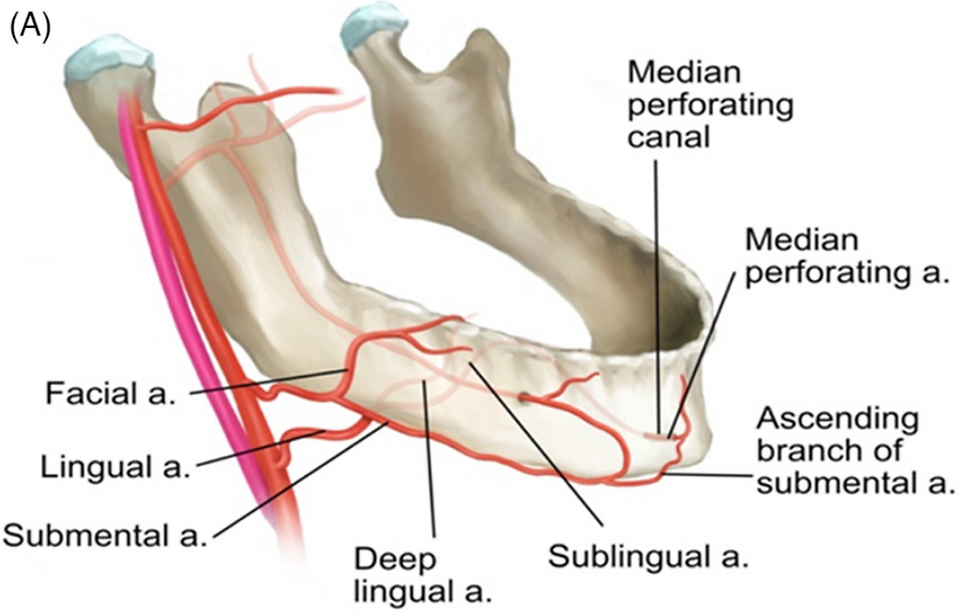
.
Vascular occlusion from filler injection, where filler inadvertently enters a vessel and causes tissue necrosis, is one of the most serious complications of facial filler. It is rare, but the risk of which is much reduced with adequate pre-injection assessment on top of in-depth anatomical knowledge as above. A case series of 3 patients presenting with unilateral tongue necrosis following HA filler injection reinforces this point. They required a total of 10 500, 88 500 and 31 500 IU of hyaluronidase through repeated injections over consecutive days to salvage.
Following injection, POCUS was used to confirm the depth of placement. The filler was sitting supra-periosteal, directly on the surface of the mandible, the correct plane for this indication. Correct depth in this location matters beyond the immediate aesthetic result as the supraperiosteal placement reduces the risk of filler migration over time compared to more superficial injections into soft tissue planes. Clinically, the labiomental crease was well-effaced, confirming both the correct placement and the desired aesthetic outcome, and obviated the need for further "blind" filler injections.
Case 2 - Trigger Finger: Confirming the Diagnosis Before Injecting
An elderly patient presented with a three to four month history of triggering of the ring finger, requiring passive straightening (straightening it out) to unlock. Clinically, the triggering was localised to the A1 pulley, at the base of the finger, the most common site. There had been no prior treatment so a steroid injection was the first line of treatment.
Before injecting, I performed a POCUS assessment. This did not reveal any discrete lump or mass. What it did show was a slightly thickened tendon (most likely due to inflammation) just distal to the A1 pulley, which confirmed why the finger was catching. As the finger bends, this thickened segment slides under A1 but then catches against its edge (see figure below), producing the "triggering" that the patient experiences. Sometimes, this gets stuck which results in the finger being "locked", and stretching it out (so that the thickened part slides back under A1) then may or may not work.

While POCUS was used to confirm the diagnosis, it also enabled me to exclude other possible causes such as a ganglion. A steroid injection (triamcinolone mixed with local anaesthetic) was then given near the A1 pulley so that it flows along the tendon sheath to act on the inflamed tendon. The value of POCUS here is therefore primarily diagnostic rather than purely for injection guidance. The patient was told to expect the sensation of fluid flowing up and down the finger as the injection went in. This was a useful heads-up that prevents unnecessary alarm for the patient.
He improved within two weeks and is happy with the result when I reviewed him at four weeks after his initial visit. This is consistent with the evidence base for steroid injection in trigger finger. The choice of steroid, is associated with up to 83% resolution when triamcinolone was given. For first-time patients, the success rate of one steroid injection alone ranges between 35 to 56%, with an overall recurrence rate of 20.3% that tended to occur around 1 year later. Surgery, at this stage, is then associated with the final and lowest triggering rate of 10%.
The evidence thus supports a stepwise approach: one injection, reassess, a second if indicated, and surgical A1 pulley release only if conservative management fails. Proceeding directly to surgery without a trial of injection is not justifiable in most cases - it is more invasive (risk of nerve damage), more costly, and unnecessary for the majority of patients who will respond to injection alone. Surgical release under WALANT is the definitive solution for those who do not respond after two injections in my practice.
Case 3 - Post-operative Seroma: When Ultrasound Prevents an Unnecessary Procedure
A patient returned after VASER liposuction performed abroad with concerns about post-operative swelling. She mentioned that her pre-operative weight was 56 kg yet her current weight was 59 kg. This was a 3 kg gain that was not explained to her. More importantly, this is a clinically significant finding. Post-operative weight gain of this magnitude after liposuction is not normal - it likely reflects a combination of fluid accumulation from a seroma, residual tumescence fluid (which the body gradually reabsorbs), and post-operative fluid shifts. This is exactly the kind of change that structured aftercare following cosmetic surgery is designed to detect and intervene, as it can potentially be life-threatening.
In fact, she had already had the seroma drained once by the overseas clinic before returning home. However, after the drainage, she noticed that her compression garments had become too loose, but she was not provided with a replacement or adjusted garments. In my opinion, after seroma aspiration, the evacuated space must be compressed immediately and adequately to minimise the risk of re-accumulation. A loose garment after drainage provides no meaningful compression.
Not unexpectedly, when the seroma re-accumulated at 2 weeks, she was already back in Singapore and did not contact the overseas clinic. It was not because she did not want to, but rather, she knew they could not do anything from afar. She had also approached several local clinics for help and no one responded. That is the reality of the lack of aftercare after cosmetic surgery done abroad.
The clinical question when I saw her in clinic was straightforward - is there residual seroma, and if so, does it need to be drained again? I performed a POCUS and it showed minimal fluid collection, approximately 0.6 cm in thickness in the subcutaneous layer only. In fact, she was quite a thin patient and I could see her bowels moving (this is a normal finding) right under. Based on the POCUS findings, I made the decision not to drain. The collection was small enough to resolve spontaneously, and an unnecessary aspiration carries its own risks such as discomfort, infection, or worse, bowel perforation and injury given how close they were.

This is where POCUS changes management. Without imaging, the clinical options are to aspirate empirically (and accept the risks above) or to watch and wait. With imaging, the decision is well-informed both for the patient and me. The size, location, and character of the collection are visible, and the threshold for intervention becomes objective rather than estimated. She was reassured and I made arrangements for her to be fitted with a new compression garment. No further intervention was required.
Case 4 - Post-Liposuction Contour Irregularity: When POCUS Characterises What the Surface Shows
A patient presented following platysmaplasty and underchin liposuction performed abroad. On examination, there was a visible indentation on one side of the neck just below the jowl area, with surrounding localised bruising.
Bedside POCUS was performed to assess the underlying tissue (see video below). There was no discrete fluid collection. The scan however, showed a clear indentation of the skin contour at the surface, with a hypoechoic (darker) area on ultrasound directly beneath and adjacent to the indentation, most likely corresponding to the bruising. The deeper muscle layer, the platysma, was visualised and appeared smooth and intact.
These findings were most consistent with early, focal fibrosis, which can develop after overly aggressive fat removal close to the dermis. When the protective fat cushion immediately beneath the skin is stripped away, the body heals by laying down dense collagen bands that anchor the skin downward, producing exactly the contour irregularity seen here. The platysma being intact and smooth was a reassuring finding, as it meant that the damage was superficial rather than deep. The patient was counselled that this should soften over three to six months with targeted scar massage.
Why POCUS Matters in Plastic Surgery
These cases illustrate the same principle, that ultrasound in the plastic surgery clinic is not about replacing clinical judgment or imaging but rather, informing in real-time. The absence of blood vessels before injecting filler, a thickened tendon that explains a triggering finger, a seroma too small to drain, and an indentation after liposuction - these findings guide what happens next, on the same day. In my practice, POCUS spares patients procedures that they don't need, and it provides my patients and I with a level of certainty that clinical examination alone may not afford.
For patients considering precision non-surgical facial rejuvenation, and hand and wrist surgery in Singapore, you can read more about fillers, and hand & wrist procedures under WALANT . For those interested in liposuction and body contouring, you can read more about my liposuction-assisted and TAP blocks in abdominoplasty approaches respectively.
Written by Dr Ng Zhi Yang, UK & Singapore accredited Plastic Surgeon.
References
Boey JJJ, Ho W, Ng ZY. Comment on "Chin Augmentation With Hyaluronic Acid: An Injection Technique Based on Anatomical Morphology". Dermatol Surg. 2024 Sep 1;50(9):886-887. doi: 10.1097/DSS.0000000000004210. Epub 2024 Apr 30. PMID: 38686929.
Pinheiro IHS, Tolentino ES, Herreira-Ferreira M, da Silva BG, Iwaki LCV, Chicarelli M. Correlation between the presence of the median perforating canal in adults with sex, age and skeletal facial patterns: A cross-sectional study. J Stomatol Oral Maxillofac Surg. 2022 Nov;123(6):e639-e642. doi: 10.1016/j.jormas.2021.11.008. Epub 2021 Nov 29. PMID: 34856386.
Thanasarnaksorn W, Thanyavuthi A, Prasertvit P, Rattanakuntee S, Jitaree B, Suwanchinda A. Case series of tongue necrosis from vascular complications after chin augmentation with hyaluronic acid: Potential pathophysiology and management. J Cosmet Dermatol. 2023 Mar;22(3):784-791. doi: 10.1111/jocd.15475. Epub 2023 Jan 26. PMID: 36700378.
Martinel V, Serrano-Belmar GA, Pelet H, Lalonde DH. Tips to Help Hand Surgeons and Therapists Do Their Own Ultrasound Examinations. Plast Reconstr Surg Glob Open. 2025 May 1;13(5):e6740. doi: 10.1097/GOX.0000000000006740. PMID: 40321329; PMCID: PMC12045548.
Mol MF, Neuhaus V, Becker SJ, Jupiter JB, Mudgal C, Ring D. Resolution and recurrence rates of idiopathic trigger finger after corticosteroid injection. Hand (N Y). 2013 Jun;8(2):183-90. doi: 10.1007/s11552-013-9493-x. PMID: 24426916; PMCID: PMC3652990.
Wojahn RD, Foeger NC, Gelberman RH, Calfee RP. Long-term outcomes following a single corticosteroid injection for trigger finger. J Bone Joint Surg Am. 2014 Nov 19;96(22):1849-54. doi: 10.2106/JBJS.N.00004. PMID: 25410501; PMCID: PMC4238395.
Schubert C, Hui-Chou HG, See AP, Deune EG. Corticosteroid injection therapy for trigger finger or thumb: a retrospective review of 577 digits. Hand (N Y). 2013 Dec;8(4):439-44. doi: 10.1007/s11552-013-9541-6. PMID: 24426963; PMCID: PMC3840755.
Satkunabalan M, Khan R, Ng ZY. UK Trainee Experience with WALANT - An Audit of 102 Cases. J Hand Surg Asian Pac Vol. 2024 Oct;29(5):458-466. doi: 10.1142/S2424835524500449. Epub 2024 Aug 30. PMID: 39205528.


Comments